John Carter Free Download Full Movie
John Wayne was born Marion Robert Morrison in Iowa, to Mary Alberta (Brown) and Clyde Leonard Morrison, a pharmacist. He was of English, Ulster-Scots, and Irish ancestry. Clyde developed a lung condition that required him to move his family from Iowa to the warmer climate of southern California, where they tried ranching in the Mojave Desert. Until the ranch failed, Marion and his younger brother swam in an irrigation ditch and rode a horse to school.
When the ranch failed, the family moved to Glendale, California, where Marion delivered medicines for his father, sold newspapers and had an Airedale dog named 'Duke' (the source of his own nickname). He did well at school both academically and in football. When he narrowly failed admission to Annapolis he went to USC on a football scholarship 1925-7.
Got him a summer job as a prop man in exchange for football tickets. On the set he became close friends with director for whom, among others, he began doing bit parts, some billed as. His first featured film was (1930). After more than 70 low-budget westerns and adventures, mostly routine, Wayne's career was stuck in a rut until Ford cast him in (1939), the movie that made him a star. He appeared in nearly 250 movies, many of epic proportions. From 1942-43 he was in a radio series, 'The Three Sheets to the Wind', and in 1944 he helped found the Motion Picture Alliance for the Preservation of American Ideals, a Conservative political organization, later becoming its President. His conservative political stance was also reflected in (1960), which he produced, directed and starred in.
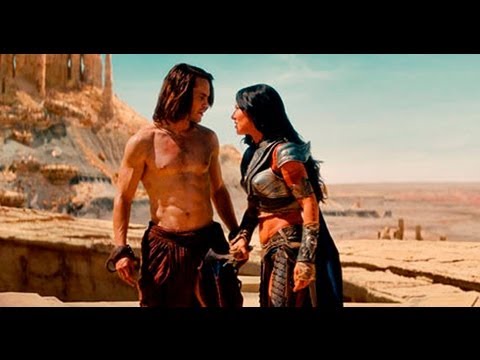

Sep 29, 2017. John Carter 2012 BRRip 999MB Hindi Dual Audio 720p Watch Online Free Download Wolrdfree4u 9xmovies. IMDB Ratings: 6.6/10. Genre: Action, Adventure, Sci-Fi. Directed: Andrew Stanton Star Cast: Taylor Kitsch, Lynn Collins, Willem Dafoe. Language: Hindi + English Video Quality: BluRay 720p. John Carter (2012) BRRip 420p 300MB Dual Audio Free Hd Movies Download. Watch Confidential Assignment 2017 Full Movie Online Free. The House Next Door Hindi Full Movie storyline: A young, happily married couple finds themselves embroiled in inexplicable domestic circumstances caused by their next door.
His patriotic stand was enshrined in (1968) which he co-directed and starred in. Over the years Wayne was beset with health problems. In September 1964 he had a cancerous left lung removed; in March 1978 there was heart valve replacement surgery; and in January 1979 his stomach was removed. He received the Best Actor nomination for (1949) and finally got the Oscar for his role as one-eyed Rooster Cogburn in (1969). A Congressional Gold Medal was struck in his honor in 1979. He is perhaps best remembered for his parts in Ford's cavalry trilogy - (1948), (1949) and (1950).
- IMDb Mini Biography By: Spouse (3) ( 1954 - 1979) (his death) (3 children) ( 1946 - 1954) (divorced) Josephine Alicia Saenz ( 1933 - 1945) (divorced) (4 children) Trade Mark (5). Most published sources refer to Wayne's birth name as Marion Michael Morrison. His birth certificate, however, gives his original name as Marion Robert Morrison. According to Wayne's own statements, after the birth of his younger brother in 1911, his parents named the newborn Robert Emmett and changed Wayne's name from Marion Robert to Marion Michael. It has also been suggested by several of his biographers that Wayne's parents actually changed his birth name from Marion Robert to Marion Mitchell. In 'Duke: The Life and Times of John Wayne' (1985), Donald Shepherd and state that when Wayne's younger brother was born, 'the Duke's middle name was changed from Robert to Mitchell....
After he gained celebrity, Duke deliberately confused biographers and others by claiming Michael as his middle name, a claim that had no basis in fact.' The evening before a shoot he was trying to get some sleep in a Las Vegas hotel. The suite directly below his was that of (never a good friend of Wayne), who was having a party. The noise kept Wayne awake, and each time he made a complaining phone call it quieted temporarily but each time eventually grew louder. Wayne at last appeared at Sinatra's door and told Frank to stop the noise. A Sinatra bodyguard of Wayne's size approached saying, 'Nobody talks to Mr.
Sinatra that way.' Wayne looked at the man, turned as though to leave, then backhanded the bodyguard, who fell to the floor, where Wayne knocked him out by crashing a chair on top of him. The party noise stopped. Arguably Wayne's worst film, (1956), in which he played Genghis Kahn, was based on a script that director had every intention of throwing into the wastebasket. According to Powell, when he had to leave his office at RKO for a few minutes during a story conference, he returned to find a very enthused Wayne reading the script, which had been in a pile of possible scripts on Powell's desk, and insisting that this was the movie he wanted to make.
As Powell himself summed it up, 'Who am I to turn down John Wayne?' According to movie industry columnist, Wayne's producers issued phony press releases when he was hospitalized for cancer surgery in September 1964, claiming the star was being treated for lung congestion. 'Those bastards who make pictures only think of the box office,' he told Bacon, as recounted in 1979 by the columnist. 'They figure Duke Wayne with cancer isn't a good image. I was too doped up at the time to argue with them, but I'm telling you the truth now. You know I never lie.'
After Bacon broke the story of the Duke's cancer, thousands of cancer victims and their relatives wrote to Wayne saying that his battle against the disease had given them hope. He underwent surgery to have a cancerous left lung removed on Thursday, September 17th, 1964, in a six-hour operation. Press releases at the time reported that Wayne was in Los Angeles' Good Samaritan Hospital to be treated for lung congestion. When Hollywood columnist went to the hospital to see Wayne, he was told by a nurse that Wayne wasn't having visitors. According to a Monday, June 27th, 1978, 'Us' magazine article, Wayne said to his nurse from his room, 'Let that son of a bitch come in.' When Bacon sat down in his room, Wayne told him, 'Well, I licked the Big C.'
Wayne confessed that his five-packs-a-day cigarette habit had caused a lung tumor the size of a golf ball, necessitating the removal of the entire lung. One day following surgery, Wayne began coughing so violently he ruptured his stitches and damaged delicate tissue. His face and hands began to swell up from a mixture of fluid and air, but the doctors didn't dare operate again so soon. Five days later they drained the fluid and repaired the stitches. On Tuesday, December 29th, 1964, Wayne held a press conference at his Encino ranch, against the advice of his agent and advisers, where he announced, 'I licked the Big C.
I know the man upstairs will pull the plug when he wants to, but I don't want to end my life being sick. I want to go out on two feet, in action.' Before he had left the hospital on October 19th, Wayne received the news that his 52-year-old brother had lung cancer. In 1974, with the Vietnam war still continuing, The Harvard Lampoon invited Wayne to The Harvard Square Theater to award him the 'Brass Balls Award' for his 'Outstanding machismo and a penchant for punching people'.
Wayne accepted and arrived riding atop an armored personnel carrier manned by the 'Black Knights' of Troop D, Fifth Regiment. Wayne took the stage and ad-libbed his way through a series of derogatory questions with adroitness, displaying an agile wit that completely won over the audience of students. He made three movies with, despite the fact that the two men had very different political ideologies. Wayne was a conservative Republican while Douglas was a very liberal Democrat. Wayne criticized Douglas for playing in (1956), and publicly criticized him for hiring blacklisted screenwriter, one of the 'Hollywood Ten', to write the screenplay for (1960). Douglas later praised Wayne as a true professional who would work with anybody if he felt they were right for the part.
The two made three movies together, but avoided discussing politics. Despite being best known as a conservative Republican, Wayne's politics throughout his life were fluid. He later claimed to have considered himself a socialist during his first year of college. As a young actor in Hollywood, he described himself as a liberal, and voted for in the 1936 presidential election. In 1938 he attended a fund raiser for a Democratic candidate in New York, but soon afterwards 'realized Democrats didn't stand for the same things I did'. Believed Wayne called himself a liberal just so he wouldn't fall out with director, an activist liberal Democrat.
It really wasn't until the 1940s that Wayne moved fully to the right on the political spectrum. But even then, he was not always in lockstep with the rest of the conservative movement - a fact that was nonetheless unknown to the public until 1978, when he openly differed with the Republican Party over the issue of the Panama Canal. Conservatives wanted America to retain full control, but Wayne, believing that the Panamanians had the right to the canal, sided with President and the Democrats to win passage of the treaty returning the canal in the Senate.
Carter openly credited Wayne with being a decisive factor in convincing some Republican Senators to support the measure. According to Michael Munn Frontpage 2010 Free Download Full Version. 's 'John Wayne: The Man Behind the Myth', in 1959, Wayne was personally told by, when the Soviet Premier was visiting the United States on a goodwill tour, that and China's had each ordered Wayne to be killed. Both dictators had considered Wayne to be a leading icon of American democracy, and thus a symbol of resistance to Communism through his active support for blacklisting in Hollywood, and they believed his death would be a major morale blow to the United States. Khrushchev told Wayne he had rescinded Stalin's order upon his predecessor's demise in March 1953, but Mao supposedly continued to demand Wayne's assassination well into the 1960s. Wayne's westerns were full of action but usually not excessively violent. 'Fights with too much violence are dull,' claimed Wayne, insisting that the straight-shooting, two-fisted violence in his movies have been 'sort of tongue-in-cheek.'
He described the violence in his films as 'lusty and a little humorous,' based on his belief that 'humor nullifies violence.' His conservative taste deplored the increasing latitude given to violence and sex in Hollywood. In the 1960s he launched a campaign against what he termed 'Hollywood's bloodstream polluted with perversion and immoral and amoral nuances.' Most of his westerns steered clear of graphic violence. Wayne tried not to make films that exploited sex or violence, deploring the vulgarity and violence in (1968), which he saw and did not like, and (1971) or (1972) which he had no desire to see. He thought (1972) was repulsive - 'after all, it's pretty hard to take your daughter to see it.' And he refused to believe that (1970) 'sold because the girl went around saying 'shit' all the way through it.'
Rather, 'the American public wanted to see a little romantic story.' He took a strong stance against nudity: 'No one in any of my pictures will ever be served drinks by a girl with no top to her dress.' It was not sex per se he was against.
'Don't get me wrong. As far as a man and a woman are concerned, I'm awfully happy there's a thing called sex,' he said, 'It's an extra something God gave us, but no picture should feature the word in an unclear manner.' He therefore saw 'no reason why it shouldn't be in pictures,' but it had to be 'healthy, lusty sex.' During a visit to London in January 1974 to appear on (1969) and (1971), Wayne caught pneumonia. For a 66-year-old man with one lung this was very serious, and eventually he was coughing so hard that he damaged a valve in his heart. This problem went undetected until March 1978, when he underwent emergency open heart surgery in Boston.
Delivered a message from the (1978), saying, 'We want you to know Duke, we miss you tonight. We expect you to amble out here in person next year, because there is nobody who can fill John Wayne's boots.' According to, that message from Hope made Wayne determined to live long enough to attend the Oscars in 1979. On Friday, January 12th, 1979, Wayne entered hospital for gall bladder surgery, which turned in a nine and a half hour operation when doctors discovered cancer in his stomach.
His entire stomach was removed. On May 2nd, Wayne returned to the hospital, where the cancer was found to have spread to his intestines. He was taken to the 9th floor of the UCLA Medical Center, where President visited him, and sent him a get well card. He went into a coma on Sunday, June 10th, 1979, and died at 5:35 P.M., in the late afternoon the next day, Monday, June 11th, 1979. Was named the #1 box office star in North America by Quigley Publications, which has published its annual Top 10 Poll of Money-Making Stars since 1932.
In all, the Duke was named to Quigley Publications' annual Top 10 Poll a record 25 times. (, with 25 appearances in the Top 10, is #2, and Wayne's contemporary, with 18 appearances, is tied for #3 with.) Wayne had the longest ride on the list, first appearing on it in 1949 and making it every year but one (1958) through 1974. In four of those years he was No. Wayne appeared in a very uncomplimentary light in the song 'Fight the Power,' from the 1990 album 'Fear of a Black Planet'. Wayne has frequently come under fire for alleged racist remarks he made about black people and Native American Indians in his infamous Playboy magazine interview from May 1971. He was also criticized by some for supporting Senator in the 1964 presidential election, after Goldwater had voted against the Civil Rights Act. However; it turned out that Goldwater was not as intolerant as people thought, and was quite progressive in his thinking on integration, but hindsight tends to rule the day.
Wayne denounced the subject of homosexuality in ' (1959) as 'too disgusting even for discussion'--even though he had not seen it and had no intention of seeing it. 'It is too distasteful,' he claimed, 'to be put on a screen designed to entertain a family, or any member of a decent family.' He considered the youth-oriented, anti-establishment film (1969) and (1969), which to his dismay won the Best Picture Oscar in 1970, as 'perverted' films.
Especially when early in 'Midnight Cowboy' dons his newly acquired Western duds and, posing in front of a mirror, utters the only words likely to come to mind at the moment one becomes a cowboy: 'John Wayne!' Wayne told Playboy magazine, 'Wouldn't you say that the wonderful love of these two men in 'Midnight Cowboy', a story about two fags, qualifies as a perverse movie?' Producer-director offered the role of Willie Stark in (1949) to Wayne.
Rossen sent a copy of the script to Wayne's agent,,who forwarded it to Wayne. After reading the script, Wayne sent it back with an angry letter attached.
In it, he told Feldman that before he sent the script to any of his other clients, he should ask them if they wanted to star in a film that 'smears the machinery of government for no purpose of humor or enlightenment', that 'degrades all relationships', and that is populated by 'drunken mothers; conniving fathers; double-crossing sweethearts; bad, bad, rich people; and bad, bad poor people if they want to get ahead.' He accused Rossen of wanting to make a movie that threw acid on 'the American way of life.' If Feldman had such clients, Wayne wrote that the agent should 'rush this script... Wayne, however, said to the agent that 'you can take this script and shove it up Robert Rossen's derriere.' Wayne later remarked that 'to make a wonderful, rough pirate was great, but, according to this picture, everybody was shit except for this weakling intern doctor who was trying to find a place in the world.' , who had played a supporting role in Wayne's (1940),eventually got the part of Stark.
In a bit of irony, Crawford was Oscar-nominated for the part of Stark and found himself competing against Wayne, who was nominated the same year for (1949). Crawford won the Best Actor Oscar. In the final years of his life, with the resignation of President and the end of the Vietnam War, Wayne's political beliefs appeared to have moderated.
He attended the inauguration of President on 20 January 1977, and along with his fellow conservative he could be seen applauding at (1978). Later in 1978, Wayne uncharacteristically sided with the Democrats and President Carter against his fellow conservative Republicans over the issue of the Panama Canal, which Wayne believed belonged to the people of Panama and not the United States of America. While filming (1969), Wayne was trying to keep his weight off with drugs - uppers for the day, downers to sleep at night.
Occasionally, he got the pills mixed up, and this led to problems on a (1965) taping in 1969. Instead of taking an upper before leaving for the filming, he took a downer - and was ready to crash by the time he arrived on the set. 'I can't do our skit,' Wayne reportedly told Martin when it was time to perform. 'I'm too doped up.
Goddamn, I look half smashed!' Naturally, Martin didn't have a problem with that. 'Hell, Duke, people think I do the show that way all the time!' The taping went on as scheduled. Although he actively supported 's failed bid for the Republican presidential nomination in 1976, Wayne paid a visit to the White House as a guest of President for his inauguration.
'I'm pleased to be present and accounted for in this capital of freedom to witness history as it happens - to watch a common man accept the uncommon responsibility he won 'fair and square' by stating his case to the American people - not by bloodshed, be-headings, and riots at the palace gates. I know I'm a member of the loyal opposition - accent on the loyal. I'd have it no other way.' After 's election as Governor of California in 1966, Wayne was exiting a victory celebration when he was asked by police not to leave the building - a mob of 300 angry anti-war demonstrators were waiting outside. Instead of cowering indoors, Wayne confronted the demonstrators head on. When protesters waved the Viet Cong flag under his nose, Wayne grew impatient.
'Please don't do that fellows,' Duke warned the assembled. 'I've seen too many kids your age wounded or dead because of that flag. So I don't take too kindly to it.' The demonstrators persisted, so he chased a group of them down an alley. In 1960 hired a blacklisted screenwriter,, to write an anti-war screenplay for a film to be called 'The Execution of Private Slovik', based on a book about the only US soldier to be executed for desertion during World War II. Wayne, who had actively supported the anti-Communist witch hunts for nearly 20 years, recalled, 'When I heard about it, I was so goddamn mad I told a reporter, 'I wonder how Sinatra's crony, Senator, feels about Sinatra hiring such a man'. The whole thing became a minefield...
I heard that Kennedy put pressure on Frank and he had to back down... He ended up paying Maltz $75,000 not to write the goddamn thing'. The film wasn't made for another 14 years ( (1974)). After he finally won the Best Actor Oscar for (1969) his career declined. (1970), seemingly having little to do with Wayne, was released to mixed reviews and moderate business.
(1970) received very poor critical reception and proved to be a commercial disappointment. (1971), pumped up with graphic action scenes and plenty of humor, made twice as much money as either of the previous two films. However, (1972) struggled to find an audience when first released, despite the fact that it received positive reviews and featured a very different performance from Wayne as an aging cattleman. (1973) was largely forgettable and (1973) garnered him his worst reviews since (1956). His attempts to emulate as a tough detective were generally ridiculed due to his age, increasing weight and the predictable nature of the plots. (1974) was only a moderate success and (1975), although it was a better picture, made even less money.
A sequel to (1969) titled (1975), co-starring, was critically reviled, but managed to be a minor hit. For the first time Wayne gave serious thought to retirement; however, he was able to make one final movie, a stark story of a gunfighter dying of cancer called (1976) which, although Wayne received some of the best reviews of his career, struggled to get its money back. He lost the leading role in (1950) to because of his refusal to work for Columbia Pictures after Columbia chief had mistreated him years before as a young contract player (Cohn had heard a rumor, which turned out to be untrue, that Waynel was pursuing a young starlet that Cohn was already having an affair with, and had him blackballed among the other Hollywood studios). Cohn had bought the _'The Gunfighter' project specifically with Wayne in mind for it, but Wayne's grudge was too deep, and Cohn sold the script to Twentieth Century-Fox, which cast Peck in the role Wayne badly wanted but refused to bend for.
When the Reno Chamber of Commerce named Peck the top western star for 1950 and presented him with the Silver Spurs award, an angry Wayne said, 'Well, who the hell decided that you were the best cowboy of the year?' Wayne also reportedly turned down the lead in 'Twelve O'Clock High,' which also became an iconic part for Peck.
Then president of the Directors Guild of America, stated in support of awarding the Congressional Gold Medal to Wayne in 1979: 'It is important for you to know that I am a registered Democrat and, to my knowledge, share none of the political views espoused by Duke. However, whether he is ill- disposed or healthy, John Wayne is far beyond the normal political sharp-shooting in this community. Because of his courage, his dignity, his integrity, and because of his talents as an actor, his strength as a leader, his warmth as a human being throughout his illustrious career, he is entitled to a unique spot in our hearts and minds. In this industry, we often judge people, sometimes unfairly, by asking whether they have paid their dues.
John Wayne has paid his dues over and over, and I'm proud to consider him a friend, and am very much in favor of my Government recognizing in some important fashion the contribution that Mr. Wayne has made.' In the mid-1930s Wayne was hired by Columbia Pictures to make several westerns for its 'B' unit. Columbia chief, a married man, soon got the idea that Wayne had made a pass at a Columbia starlet with whom Cohn was having an affair. When he confronted Wayne about it Wayne denied it, but Cohn called up executives at other studios and told them that Wayne would show up for work drunk, was a womanizer and a troublemaker and requested that they not hire him.
Wayne didn't work for several months afterward, and when he discovered what Cohn had done, he burst into Cohn's office at Columbia, grabbed him by the neck and threatened to kill him. After he cooled off he told Cohn that 'as long as I live, I will never work one day for you or Columbia no matter how much you offer me.' Later, after Wayne had become a major star, he received several lucrative film offers from Columbia, including the lead in (1950), all of which he turned down cold. Even after Cohn died in 1958, Wayne still refused to entertain any offers whatsoever from Columbia Pictures, including several that would have paid him more than a a million dollars. In the late 1970s Wayne made a series of commercials for the Great Western Savings Bank in Los Angeles. The day after the first one aired, a man walked into a GW Bank branch in West Hollywood with a suitcase, asked to see the bank manager, and when he was shown to the manager's desk, he opened up the suitcase to reveal $500,000 in cash.
He said, 'If your bank is good enough for John Wayne, it's good enough for me.' He had just closed his business and personal accounts at a rival bank down the street and walked to the GW branch to open accounts there because John Wayne had endorsed it. In his later years Wayne lived near Newport Beach, just south of Los Angeles, where he had a beach house and a yacht, 'The Wild Goose'. His house has been torn down, but The Wild Goose sails on. It's now a tour boat offering dinner cruises to Wayne fans young and old alike. Originally a decommissioned Navy minesweeper, it was rebuilt and customized by Wayne as a yacht; the custom interior has polished wood almost everywhere you look.
It was there that in his later years he often entertained, hosting card games with his good friends, and other name stars of the time. In the DVD documentary for (1979), says he first met Wayne at the memorial service for. The two became friends and Spielberg offered the role of Gen.
He sent Wayne the script and got a call back the same day, criticizing Spielberg for making a film that Wayne felt was anti-American. The two remained friends and never discussed the film again. Spielberg says that later on Wayne pitched him a script idea about a camel race in Morocco starring Wayne and long-time friend and co-star.
Spielberg says it sounded like a good idea. However, Wayne later passed away and the film was never made. Wayne's name consistently came up over the years for proposals that he portray WWII General George S. Through the 1950's studios proposed films about Patton, but Patton's family objected to such projects and objected to Wayne specifically. In the mid 1960's he was director 'Michael Anderson's choice to play Patton in a Columbia Pictures epic, '16th of December: The Battle of the Bulge', which had the blessing of Eisenhower and the Defence Department, but the project was abandoned after Warner Brothers appropriated the title (1965) for a generic war film with. Finally Wayne was considered in the role for (1970) ultimately played by, turning it down at one point, a decision he reportedly later regretted.
One of Kurt Russell's actor heroes since childhood. Kurt has an impressive and uncanny ability to imitate John Wayne's voice and demeanor. This was evident during one particular bar scene with Vanessa Ferlito's character in the movie (Grindhouse) Death Proof (2007) where his character (Stuntman Mike) says - 'You know how people say 'you're okay in my book' or 'in my book, that's no good'? Well, I actually have a book, and everybody I ever meet goes in this book, and now I've met you and you're going in the book. Only I'm afraid I must file you under chicken shit'.
Personal Quotes (170). I made up my mind that I was going to play a real man to the best of my ability. I felt many of the western stars of the twenties and thirties were too goddamn perfect. They never drank or smoked. They never wanted to go to bed with a beautiful girl. They never had a fight.
A heavy might throw a chair at them, and they just looked surprised and didn't fight in this spirit. They were too goddamn sweet and pure to be dirty fighters. Well, I wanted to be a dirty fighter if that was the only way to fight back. If someone throws a chair at you, hell, you pick up a chair and belt him right back. I was trying to play a man who gets dirty, who sweats sometimes, who enjoys kissing a gal he likes, who gets angry, who fights clean whenever possible but will fight dirty if he has to. You could say I made the western hero a roughneck. We must always look to the future.
Tomorrow - the time that gives a man just one more chance - is one of the many things that I feel are wonderful in life. So's a good horse under you. Or the only campfire for miles around. Or a quiet night and a nice soft hunk of ground to sleep on. A mother meeting her first-born. The sound of a kid calling you dad for the first time.
There's a lot of things great about life. But I think tomorrow is the most important thing. Comes in to us at midnight very clean. It's perfect when it arrives and it puts itself in our hands. It hopes we've learned something from yesterday. I'm not going to give you those I-was-a-poor-boy-and-I-pulled-myself-up-by-my-bootstraps-stories, but I've gone without a meal or two in my lifetime, and I still don't expect the government to turn over any of its territory to me.
Hard times aren't something I can blame my fellow citizens for. Years ago, I didn't have all the opportunities, either. But you can't whine and bellyache 'cause somebody else got a good break and you didn't, like these Indians are. We'll all be on a reservation soon if the socialists keep subsidizing groups like them with our tax money. Have you ever heard of some fellows who first came over to this country?
You know what they found? They found a howling wilderness, with summers too hot and winters freezing, and they also found some unpleasant little characters who painted their faces. Do you think these pioneers filled out form number X6277 and sent in a report saying the Indians were a little unreasonable? Did they have insurance for their old age, for their crops, for their homes? They did not! They looked at the land, and the forest, and the rivers.
They looked at their wives, their kids and their houses, and then they looked up at the sky and they said, 'Thanks, God, we'll take it from here.' I don't think had any kind of respect for me as an actor until I made (1948) for.
I was never quite sure what he did think of me as an actor. I know now, though. Because when I finally won an Oscar for my role as Rooster Cogburn in (1969), Ford shook my hand and said the award was long overdue me as far as he was concerned. Right then, I knew he'd respected me as an actor since (1939), even though he hadn't let me know it.
He later told me his praise earlier, might have gone to my head and made me conceited, and that was why he'd never said anything to me, until the right time. To me, (1969) was distasteful. It would have been a good picture without the gore.
Pictures go too far when they use that kind of realism, when they have shots of blood spurting out and teeth flying, and when they throw liver out to make it look like people's insides. 'The Wild Bunch' was one of the first to go that far in realism, and the curious went to see it. That may make the bankers and stock promoters think that it is a necessary ingredient for successful motion pictures.
They seem to forget the one basic principle of our business - illusion. We're in the business of magic.
I don't think it hurts a child to see anything that has the illusion of violence in it. All our fairy tales have some kind of violence - the good knight riding to kill the dragon, etc. Why do we have to show the knight spreading the serpent's guts all over the candy mountain?
I think it was sad that Brando [] did what he did. If he had something to say, he should have appeared that night and stated his views instead of taking some little unknown girl and dressing her up in an Indian outfit.
What he was doing was trying to avoid the issue that was really on his mind, which was the provocative story of (1972). Let's just say I haven't made a particular point of seeing that particular picture.
Brando is one of the finest actors we've had in the business, and I'm only sorry he didn't have the benefit of older, more established friends - as I did - to help him choose the proper material in which to use his talent. [December 1973] They're trying to crucify Nixon [], but when they're writing the history of this period, Watergate will be no more than a footnote. Believe me, I have a high respect for the bulldogged way in which our President has been able to continue to administrate this government, in spite of the articulate liberal press - whose only purpose is to sell toilet paper and Toyotas - and in spite of the ambitious politicians who would deny him the help and encouragement that a man needs to face the problems of this country. I endorsed 's attitudes, but I knew nothing of his private affairs. I was sadly disappointed to discover his feet of clay. The only way to get 520,000 men home - men who had been practically sneaked into Vietnam in the first place - was to make the decision to mine Haiphong Harbor. President [] had the courage to make that decision, and when the other side started using prisoners of war as pawns, he had to make the awesome decision to bomb Hanoi.
Which he did, and then he brought our prisoners of war home. Richard Nixon and I have had a long acquaintance.
I respected him as a goodly man - winning or losing • over the years, and I think he should be standing in the crowning glory today for his accomplishments. Instead, they've chosen to blame him for the gradual growth of hypocrisy and individual ambition that have made our political system distasteful to the public. [1973] My build-up was done through constant exposure. By the time I went overseas to visit our boys during the Second World War, they had already seen my movies when they were back home.
Now their kids are grown up and their kids are seeing my movies. I'm part of the family... I think and have a chance of becoming lasting stars. And certainly that big kid - what the hell's his name?
Jesus, I have such a hard time remembering my own name sometimes. Oh, you know the one I mean, that big kid, the one that's been directing some of his own movies lately. Yeah, that's the one -!
Was like a father to me, like a big brother. I got word that he wanted to see me at his home in Palm Springs, and when I got there, he said, 'Hi Duke, down for the deathwatch?'
'Hell no,' I said, 'you'll bury us all.' But he looked so weak.
We used to be a triumvirate - Ford and me and a guy named. The day I went to Palm Springs, Ford said, 'Duke, do you ever think of Ward?' 'All the time,' I said. 'Well, let's have a drink to Ward,' he said. So I got out the brandy, gave him a sip and took one for myself. 'All right, Duke,' he said finally, 'I think I'll rest for a while.'
I went home, and that was Pappy Ford's last day. Sure I wave the American flag. Do you know a better flag to wave? Sure I love my country with all her faults. I'm not ashamed of that, never have been, never will be. I was proud when President Nixon [] ordered the mining of Haiphong Harbor, which we should have done long ago, because I think we're helping a brave little country defend herself against Communist invasion. That's what I tried to show in (1968) and I took plenty of abuse from the critics.
Did you ever see reviews like that? Reviews with hatred and nastiness. [his speech at (1970)] Wow! Ladies and gentlemen, I'm no stranger to this podium. I've come up here and picked up these beautiful golden men before, but always for friends. One night I picked up two: one for Admiral and one for our beloved. I was very clever and witty that night - the envy of, even,.
But tonight I don't feel very clever, very witty. I feel very grateful, very humble, and I owe thanks to many, many people. I want to thank the members of the Academy.
To all you people who are watching on television, thank you for taking such warm interest in our glorious industry. There's a lot of yella bastards in the country who would like to call patriotism old-fashioned. With all that leftist activity, I was quite obviously on the other side.
I was invited at first to a coupla cell meetings, and I played the lamb to listen to 'em for a while. The only guy that ever fooled me was the director. I made a picture with him called (1945). He started talking about the masses, and as soon as he started using that word - which is from their book, not ours - I knew he was a Commie.END.
[about the death of 's son, who was killed in Vietnam] Jesus, that was a terrible thing about Gloria and Jimmy Stewart's kid getting killed over there. It makes you want to cry. At least Jimmy was over there to see the kid a few months ago. That's something.
But it makes you want to cry. And []'s going was terrible. He was terminal since they opened him up. I know what he went through. They ripped a lung out of me.
I thank God I'm still here. All the real motion picture people have always made family pictures.
But the downbeats and the so-called intelligentsia got in when the government stupidly split up the production companies and the theaters. The old giants--[], [], even, despite the fact that personally I couldn't stand him--were good for this industry.
Now the goddamned stock manipulators have taken over. They don't know a goddamned thing about making movies. They make something dirty, and it makes money, and they say, 'Jesus, let's make one a little dirtier, maybe it'll make more money'.
And now even the bankers are getting their noses into it. I'll give you an example.
Take that girl,, a refreshing, openhearted girl, a wonderful performer. Her stint was (1964) and (1965). But she wanted to be a. And they went along with her, and the picture fell flat on its ass. A [] would have told her, 'Look, my dear, you can't change your sweet and lovely image'. But you know, I'm very conscious that people criticize Hollywood.
Yet we've created a form, the Western, that can be understood in every country. The good guys against the bad guys. And the horse is the best vehicle of action in our medium. You take action, a scene, and scenery, and cut them together, and you never miss.
Action, scene, scenery. But when you think about the Western--ones I've made, for example. (1939), (1948), (1956), a picture named (1953) that had a little depth to it--it's an American art form.
It represents what this country is about. In (1969), for example, that scene where Rooster shoots the rat.
That was a kind of reference to today's problems. Oh, not that 'True Grit' has a message or anything. But that scene was about less accommodation, and more justice. They keep bringing up the fact that America's for the downtrodden.
But this new thing of genuflecting to the downtrodden, I don't go along with that. We ought to go back to praising the kids who get good grades, instead of making excuses for the ones who shoot the neighborhood grocery man. But, hell, I don't want to get started on that! But back to (1969). Used the backgrounds in such a way that it became almost a fantasy. Remember that one scene, where old Rooster is facing those four men across the meadow, and he takes the reins in his teeth and charges?
Fill your hands, you varmints! That's Henry at work. It's a real meadow, but it looks almost dreamlike. Henry made it a fantasy and yet he kept it an honest Western. You get something of that in the character of Rooster.
Well, they say he's not like what I've done before, and I even say that, but he does have facets of the John Wayne character, huh? I think he does. Of course, they give me that John Wayne stuff so much, claim I always play the same role. Seems like nobody remembers how different the fellas were in (1952).
Or (1949), where I was 35 playing a man of 65. To stay a star, you have to bring along some of your own personality. Thousands of good actors can carry a scene, but a star has to carry the scene and still, without intruding, allow some of his character into it.
[on (1969)] And that ending. I liked that. You know, in the book Mattie loses her hand from the snakebite, and I die, and the last scene in the book has her looking at my grave. But the way wrote the screenplay, she gave it an uplift. Mattie and Rooster both go to visit her family plot, after she gets cured of the snakebite.
By now it's winter. And she offers to let Rooster be buried there some day, seeing as how he has no family of his own. Rooster's happy to accept, long as he doesn't have to take her up on it too quick. So then he gets on his horse and says, 'Come and see a fat old man sometime'.
And then he spurs the horse and jumps a fence, just to show he still can. I'm glad I won't be around much longer to see what they do with it. The men who control the big studios today are stock manipulators and bankers. They know nothing about our business. They're in it for the buck. The only thing they can do is say, 'Jeez, that picture with what's-her-name running around the park naked made money, so let's make another one.
If that's what they want, let's give it to them.' Some of these guys remind me of high-class whores. Look at 20th Century-Fox, where they're making movies like (1970).
Why doesn't that son of a bitch get himself a striped silk shirt and learn how to play the piano? Then he could work in any room in the house.
As much as I couldn't stand some of the old-time moguls - especially - these men took an interest in the future of their business. They had integrity. There was a stretch when they realized that they'd made a hero out of the goddamn gangster heavy in crime movies, that they were doing a discredit to our country.
So the moguls voluntarily took it upon themselves to stop making gangster pictures. No censorship from the outside. They were responsible to the public. But today's executives don't give a damn. In their efforts to grab the box office that these sex pictures are attracting, they're producing garbage. They're taking advantage of the fact that nobody wants to be called a bluenose.
But they're going to reach the point where the American people will say, 'The hell with this!' And once they do, we'll have censorship in every state, in every city, and there'll be no way you can make even a worthwhile picture for adults and have it acceptable for national release. Every time they rate a picture, they let a little more go. Ratings are ridiculous to begin with. There was no need for rated pictures when the major studios were in control.
Movies were once made for the whole family. Now, with the kind of junk the studios are cranking out-and the jacked-up prices they're charging for the privilege of seeing it - the average family is staying home and watching television. I'm quite sure that within two or three years, Americans will be completely fed up with these perverted films.
Perhaps we have run out of imagination on how to effect illusion because of the satiating realism of a real war on television. But haven't we got enough of that in real life? Why can't the same point be made just as effectively in a drama without all the gore? The violence in my pictures, for example, is lusty and a little bit humorous, because I believe humor nullifies violence. Like in one picture, directed by [ (1965)], this heavy was sticking a guy's head in a barrel of water. I'm watching this and I don't like it one bit, so I pick up this pick handle and I yell, 'Hey!' And clock him across the head.
Down he went--with no spurting blood. Well, that got a hell of a laugh because of the way I did it.
That's my kind of violence. They made me a singing cowboy. The fact that I couldn't sing--or play the guitar--became terribly embarrassing to me, especially on personal appearances. Every time I made a public appearance, the kids insisted that I sing 'The Desert Song' or something. But I couldn't take along the fella who played the guitar out on one side of the camera and the fella who sang on the other side of the camera.
So finally I went to the head of the studio and said. 'Screw this, I can't handle it.' And I quit doing those kind of pictures. They went out and brought the best hillbilly recording artist in the country to Hollywood to take my place. For the first couple of pictures, they had a hard time selling him, but he finally caught on.
His name was. It was 1939 before I made (1939)--the picture that really made me a star.
Sure it did--even if it took the industry 40 years to get around to it [awarding him an Oscar]. But I think both of my two previous Oscar nominations--for (1949) and (1949)--were worthy of the honor. I know the Marines and all the American armed forces were quite proud of my portrayal of Stryker, the Marine sergeant in 'Iwo'. At an American Legion convention in Florida, General told me, 'You represent the American serviceman better than the American serviceman himself.' And, at 42, in 'She Wore a Yellow Ribbon' I played the same character that I played in (1969) at 62. But I really didn't need an Oscar. I'm a box-office champion with a record they're going to have to run to catch.
And they won't. Luckily so far, it seems they kind of consider me an older friend, somebody believable and down-to-earth. I've avoided being mean or petty, but I've never avoided being rough or tough. I've only played one cautious part in my life, in (1939). My parts have ranged from that rather dull character to Ralls in (1948), who was a nice enough fella sober, but bestial when he was drunk, and certainly a rebel. I was also a rebel in (1942) with.
I've played many parts in which I've rebelled against something in society. I was never much of a joiner. Kids do join things, but they also like to consider themselves individuals capable of thinking for themselves. Entertainers like and his cronies who went up to Northern California and held placards to save the life of that guy. I just don't understand these things.
I can't understand why our national leadership isn't willing to take the responsibility of leadership instead of checking polls and listening to the few that scream. Why are we allowing ourselves to become a mobocracy instead of a democracy? When you allow unlawful acts to go unpunished, you're moving toward a government of men rather than a government of law; you're moving toward anarchy.
And that's exactly what we're doing. We allow dirty loudmouths to publicly call policemen pigs; we let a fella like make a speech to the Black Panthers saying that the ghetto is theirs, and that if police come into it, they have a right to shoot them. Why is that dirty, no-good son of a bitch allowed to practice law? Quite obviously, the Black Panthers represent a danger to society.
They're a violent group of young men and women - adventurous, opinionated and dedicated - and they throw their disdain in our face. Now, I hear some of these liberals saying they'd like to be held as white hostages in the Black Panther offices and stay there so that they could see what happens on these early-morning police raids. It might be a better idea for these good citizens to go with the police on a raid. When they search a Panther hideout for firearms, let these do-gooders knock and say, 'Open the door in the name of the law' and get shot. They're standing up for what they feel is right, not for what they think is right--'cause they don't think. As a kid, the Panther ideas probably would have intrigued me.
When I was a little kid, you could be adventurous like that without hurting anybody. There were periods when you could blow the valve and let off some steam. Like Halloween. You'd talk about it for three months ahead of time, and then that night you'd go out and stick the hose in the lawn, turn it on and start singing 'Old Black Joe' or something. And when people came out from their Halloween party, you'd lift the hose and wet them down. And while you were running, the other kids would be stealing the ice cream from the party.
All kinds of rebellious actions like that were accepted for that one day. Then you could talk about it for three months afterward. That took care of about six months of the year.
There was another day called the Fourth of July, when you could go out and shoot firecrackers and burn down two or three buildings. So there were two days a year.
Now those days are gone. You can't have firecrackers, you can't have explosives, you can't have this, don't do this, don't do that. A continual 'don't' until the kids are ready to do almost anything rebellious. The government makes the rules, so now the running of our government is the thing they're rebelling against. For a lot of those kids, that's just being adventurous. They're not deliberately setting out to undermine the foundations of our great country.
They're doing their level worst--without knowing it. How 'bout all the kids that were at the Chicago Democratic Convention?
They were conned into doing hysterical things by a bunch of activists. A lot of Communist-activated people. I know Communism's a horrible word to some people. They laugh and say, 'He'll be finding them under his bed tomorrow.'
But perhaps that's because their kid hasn't been inculcated yet. Dr., the political philosopher at the University of California at San Diego, who is quite obviously a Marxist, put it very succinctly when he said, 'We will use the anarchists.' [] has become a hero only for an articulate clique. The men that give me faith in my country are fellas like, not the Marcuses. They've attempted in every way to humiliate Agnew.
They've tried the old Rooseveltian thing of trying to laugh him out of political value of his party. Every comedian's taken a crack at him. But I bet if you took a poll today, he'd probably be one of the most popular men in the United States. Nobody likes Spiro Agnew but the people. Yet he and other responsible government leaders are booed and pelted when they speak on college campuses.
Well, when I went to USC, if anybody had gone into the president's office and shit in his wastepaper basket and used the dirt to write vulgar words on the wall, not only the football team but the average kid on campus would have gone to work on the guy. There doesn't seem to be respect for authority anymore; these student dissenters act like children who have to have their own way on everything.
They're immature and living in a little world all their own. Just like hippie dropouts, they're afraid to face the real competitive world.
Many of us were being invited to supposed social functions or house parties--usually at well-known Hollywood writers' homes--that turned out to be Communist recruitment meetings. Suddenly, everybody from makeup men to stagehands found themselves in seminars on Marxism. Take this colonel I knew, the last man to leave the Philippines on a submarine in 1942. Pierluigi Ighina L Atomo Magnetico Pdf Files. He came back here and went to work sending food and gifts to U.S. Prisoners on Bataan.
He'd already gotten a Dutch ship that was going to take all this stuff over. The State Department pulled him off of it and sent the poor bastard out to be the technical director on my picture (1945), which was being made. I knew that he and a whole group of actors in the picture were pro-Reds, and when I wasn't there, these pro-Reds went to work on the colonel. He was a Catholic, so they kidded him about his religion: They even sang 'The Internationale' at lunchtime. He finally came to me and said, 'Mr.
Wayne, I haven't anybody to turn to. These people are doing everything in their power to belittle me.' So I went to Dmytryk and said, 'Hey, are you a Commie?' He said, 'No, I'm not a Commie. My father was a Russian.
I was born in Canada. But if the masses of the American people want communism, I think it'd be good for our country.' When he used the word 'masses,' he exposed himself. That word is not a part of Western terminology. So I knew he was a Commie. Well, it later came out that he was. I also knew two other fellas who really did things that were detrimental to our way of life.
One of them was, the guy who wrote the screenplay for (1952), and the other was, the one who made the picture about, (1949). In Rossen's version of 'All the King's Men', which he sent me to read for a part, every character who had any responsibility at all was guilty of some offense against society.
To make Huey Long a wonderful, rough pirate was great; but, according to this picture, everybody was a shit except for this weakling intern doctor who was trying to find a place in the world. I sent the script back to, my agent, and said, 'If you ever send me a script like this again, I'll fire you.' Ironically, it won the Academy Award. 'High Noon' was even worse.
Everybody says 'High Noon' is a great picture because wrote some great music for it and because and were in it. So it's got everything going for it. In that picture, four guys come in to gun down the sheriff.
He goes to the church and asks for help and the guys go, 'Oh well, oh gee.' And the women stand up and say, 'You're rats. You're rats.' So Cooper goes out alone. It's the most un-American thing I've ever seen in my whole life. The last thing in the picture is ole Coop putting the United States marshal's badge under his foot and stepping on it. I'll never regret having helped run Foreman out of this country.
Running him out of the country is just a figure of speech. But I did tell him that I thought he'd hurt Gary Cooper's reputation a great deal.
Foreman said, 'Well, what if I went to England?' I said, 'Well, that's your business.'
He said, 'Well, that's where I'm going.' I've always followed my father's advice: He told me, first, to always keep my word and, second, to never insult anybody unintentionally. If I insult you, you can be goddamn sure I intend to. And, third, he told me not to go around looking for trouble. Well, I guess I have had some problems sticking to that third rule, but I'd say I've done pretty damn well with the first and second. I try to have good enough taste to insult only those I wish to insult.
I've worked in a business where it's almost a requirement to break your word if you want to survive, but whenever I signed a contract for five years or for a certain amount of money, I've always lived up to it. I figured that if I was silly enough to sign it, or if I thought it was worth while at the time, that's the way she goes.
I'm not saying that I won't drive as hard a bargain as I can. In fact, I think more about that end of the business than I did before, ever since 1959, when I found that my business manager was playing more than he was working. I didn't know how bad my financial condition was until my lawyer and everybody else said, 'Let's all have a meeting and figure out exactly where you stand.' At the conclusion of that meeting, it was quite obvious that I wasn't in anywhere near the shape that I thought I was or ought to be after twenty-five years of hard work. If they'd given me the time to sell everything without taking a quick loss, I would have come out about even. Oil and everything else.
Not enough constructive thinking had been done. Then there was the shrimp fiasco. One of my dearest friends was Robert Arias, who was married to the ballerina Dame.
While his brother Tony was alive, we had control of about seventy per cent of the shrimp in Panama. We were also buying some island property near the Panama Canal. We were going to put in a ship-repair place.
There were tugs standing down there at $150 a day to drag ships back up to the United States, because repair prices in the Canal Zone were so high. But our plans fell through when Tony was killed in an airplane accident. Around a half a million dollars was lost. If anything happened to me now, I have the right amount of insurance. I hope and pray, for my estate.
I'm about as big a rancher as there is in Arizona, so I have outside interests other than my motion-picture work. The turning point was the moment I decided to watch what was being done with my money.
I had two operations six days apart - one for a cancer that was as big as a baby's fist, and then one for edema. I wasn't so uptight when I was told about the cancer. My biggest fear came when they twisted my windpipe and had to sew me back together a second time. When my family came in to see me and I saw the looks on their faces, I figured, 'Well, Jeez, I must be just about all through.
I kept my spirits up by thinking about God and my family and my friends and telling myself, 'Everything will be all right.' I licked the Big C. I know the man upstairs will pull the plug when he wants to, but I don't want to end up my life being sick.
I want to go out on two feet - in action. The operation hasn't impeded anything except that I get short of breath quickly. Particularly in the higher altitudes, that slows me down.
I still do my own fights and all that stuff. I'd probably do a little bit more if I had more wind, but I still do more than my share. Nobody else does anything any more than I do, whether they're young or old. There's been no top authority saying what marijuana does to you. I really don't know that much about it. I tried it once, but it didn't do anything to me.
The kids say it makes them think they're going thirty miles an hour when they're going eighty. If that's true, marijuana use should definitely be stopped. When I went to Hong Kong, I tried opium once, as a clinical thing. I heard it didn't make you sick the first time, and Jesus, it just didn't affect me one way or the other, either.
So I'm not a very good judge of how debasing it is. Well, at one time in my career, I guess sexuality was part of my appeal. But God, I'm 63 years old now.
How the hell do I know whether I still convey that? It's pretty hard to answer a question like, 'Are you attractive to broads?' All that crap comes from the way I walk, I guess. There's evidently a virility in it. Otherwise, why do they keep mentioning it? But I'm certainly not conscious of any particular walk.
I guess I must walk different than other people, but I haven't gone to any school to learn how. 's the most terrific fella of our century. If I had to make a speech on the subject of Communism, I could think of nobody that had a better insight or that said things concerning the future that have proven out so well. Let me read to you from a book of his quotes.
While [] was giving the world Communism, Churchill said, 'I tell you--it's no use arguing with a Communist. It's no good trying to convert a Communist, or persuade him. You can only deal with them on the following basis... You can only do it by having superior force on your side on the matter in question--and they must also be convinced that you will use--you will not hesitate to use these forces if necessary, in the most ruthless manner.
You have not only to convince the Soviet government that you have superior force--but that you are not restrained by any moral consideration if the case arose from using that force with complete material ruthlessness. And that is the greatest chance of peace, the surest road to peace. Churchill was unparalleled. Above all, he took a nearly beaten nation and kept their dignity for them.
[in 1971] Republic Pictures gave me a screen credit on one of the early pictures and called me Michael Burns. On another one they called me Duke Morrison. Then they decided Duke Morrison didn't have enough prestige. My real name, Marion Michael Morrison, didn't sound American enough for them. So they came up with John Wayne. I didn't have any say in it, but I think it's a great name. It's short and strong and to the point.
It took me a long time to get used to it, though. I still don't recognize it when somebody calls me John... The guy you see on the screen really isn't me.
I'm Duke Morrison and I never was and never will be a film personality like John Wayne. I know him well. I'm one of his closest students. I have to be. I make a living out of him.